from pathlib import Path
import numpy as np
import pandas as pd
import matplotlib.pyplot as plt
import lapylace as lp

root = Path("../../ROS-Examples")

def coef_medians(fit):
    return pd.Series(
        [np.median(fit.alpha_draws()), *np.median(fit.beta_draws(), axis=0)],
        index=["Intercept", *fit.columns],
    )

def fit_glm(formula, data, family=None, seed=1, prior_scale=2.5, intercept_scale=5, aux_scale=10, **kwargs):
    return lp.stan_glm(
        formula,
        data=data,
        family=family or lp.gaussian(),
        prior=lp.normal(0, prior_scale),
        prior_intercept=lp.normal(0, intercept_scale),
        prior_aux=lp.exponential(aux_scale),
        chains=2,
        parallel_chains=2,
        iter_warmup=300,
        iter_sampling=500,
        seed=seed,
        refresh=100,
        **kwargs,
)Golf putting accuracy
Source: Golf/golf.Rmd
The data are grouped binomial counts. The logistic regression below uses lapylace.stan_glm with a binomial family and trial counts, followed by the geometry-based likelihood from the book.
Setup
from scipy.special import expit
from scipy.stats import norm, binom
from scipy.optimize import minimize_scalar

golf = pd.read_csv(root / "Golf/data/golf.txt", sep=r"\s+", skiprows=2)
golf["p_hat"] = golf["y"] / golf["n"]
golf["se"] = np.sqrt(golf["p_hat"] * (1 - golf["p_hat"]) / golf["n"])
r = (1.68 / 2) / 12
R = (4.25 / 2) / 12
golf.head()| x | n | y | p_hat | se | |
|---|---|---|---|---|---|
| 0 | 2 | 1443 | 1346 | 0.932779 | 0.006592 |
| 1 | 3 | 694 | 577 | 0.831412 | 0.014212 |
| 2 | 4 | 455 | 337 | 0.740659 | 0.020547 |
| 3 | 5 | 353 | 208 | 0.589235 | 0.026185 |
| 4 | 6 | 272 | 149 | 0.547794 | 0.030178 |
fit_logit = fit_glm("y ~ x", golf, family=lp.binomial(), seed=18601, prior_scale=2.5, intercept_scale=5, trials="n")
coef = coef_medians(fit_logit)
fit_logit.summary(["alpha", "beta"]) | Mean | MCSE | StdDev | 5% | 50% | 95% | N_Eff | N_Eff/s | R_hat | |
|---|---|---|---|---|---|---|---|---|---|
| alpha | 2.235940 | 0.004140 | 0.061303 | 2.141130 | 2.236560 | 2.336880 | 219.294 | 10442.6 | 1.00897 |
| beta[1] | -0.256069 | 0.000439 | 0.006606 | -0.267045 | -0.256062 | -0.245914 | 226.716 | 10796.0 | 1.00431 |
x_grid = np.linspace(0, 1.1 * golf.x.max(), 300)
grid = pd.DataFrame({"x": x_grid, "n": 1})
p_logit = fit_logit.posterior_epred(grid).mean(axis=0)
fig, ax = plt.subplots(figsize=(7,5))
ax.errorbar(golf.x, golf.p_hat, yerr=golf.se, fmt="o", color="black", lw=.8)
ax.plot(x_grid, p_logit, color="black")
ax.set(xlabel="Distance from hole (feet)", ylabel="Probability of success", ylim=(0,1.02))
[Text(0.5, 0, 'Distance from hole (feet)'),
Text(0, 0.5, 'Probability of success'),
(0.0, 1.02)]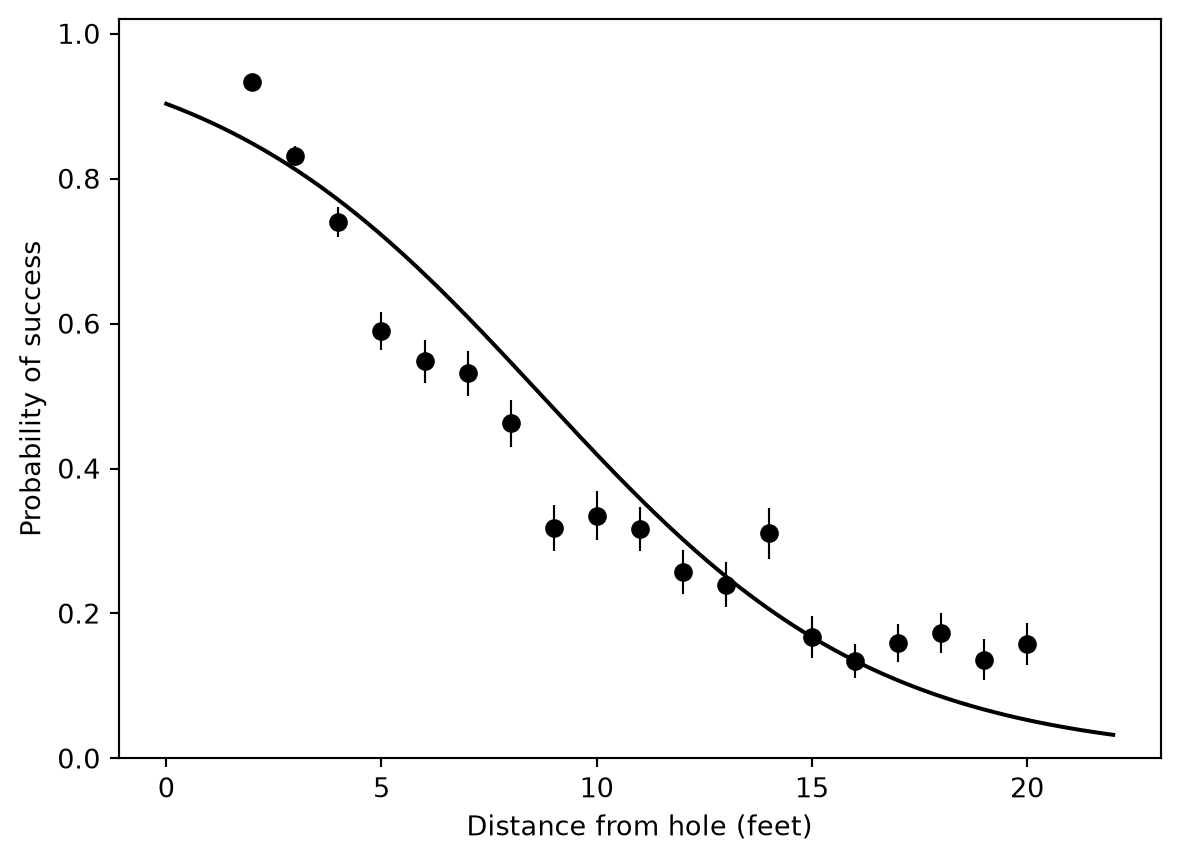
def p_geometry(x, sigma):
    x = np.asarray(x)
    p = np.ones_like(x, dtype=float)
    ok = x > (R - r)
    p[ok] = 2 * norm.cdf(np.arcsin((R - r) / x[ok]) / sigma) - 1
    return np.clip(p, 1e-9, 1 - 1e-9)

def neg_loglik(log_sigma):
    sigma = np.exp(log_sigma)
    p = p_geometry(golf.x.to_numpy(), sigma)
    return -binom.logpmf(golf.y.to_numpy(), golf.n.to_numpy(), p).sum()

opt = minimize_scalar(neg_loglik, bounds=(-6, 1), method="bounded")
sigma_hat = np.exp(opt.x)
sigma_hat, sigma_hat * 180 / np.pi
(np.float64(0.026645440807141815), np.float64(1.5266713015148838))