from pathlib import Path
import numpy as np
import pandas as pd
import matplotlib.pyplot as plt
import lapylace as lp

root = Path("../../ROS-Examples")

def coef_medians(fit):
    return pd.Series(
        [np.median(fit.alpha_draws()), *np.median(fit.beta_draws(), axis=0)],
        index=["Intercept", *fit.columns],
    )

def fit_glm(formula, data, family=None, seed=1, prior_scale=2.5, intercept_scale=5, aux_scale=10, **kwargs):
    return lp.stan_glm(
        formula,
        data=data,
        family=family or lp.gaussian(),
        prior=lp.normal(0, prior_scale),
        prior_intercept=lp.normal(0, intercept_scale),
        prior_aux=lp.exponential(aux_scale),
        chains=2,
        parallel_chains=2,
        iter_warmup=300,
        iter_sampling=500,
        seed=seed,
        refresh=100,
        **kwargs,
)Elections and the economy: Hibbs regression
Source: ElectionsEconomy/hibbs.Rmd
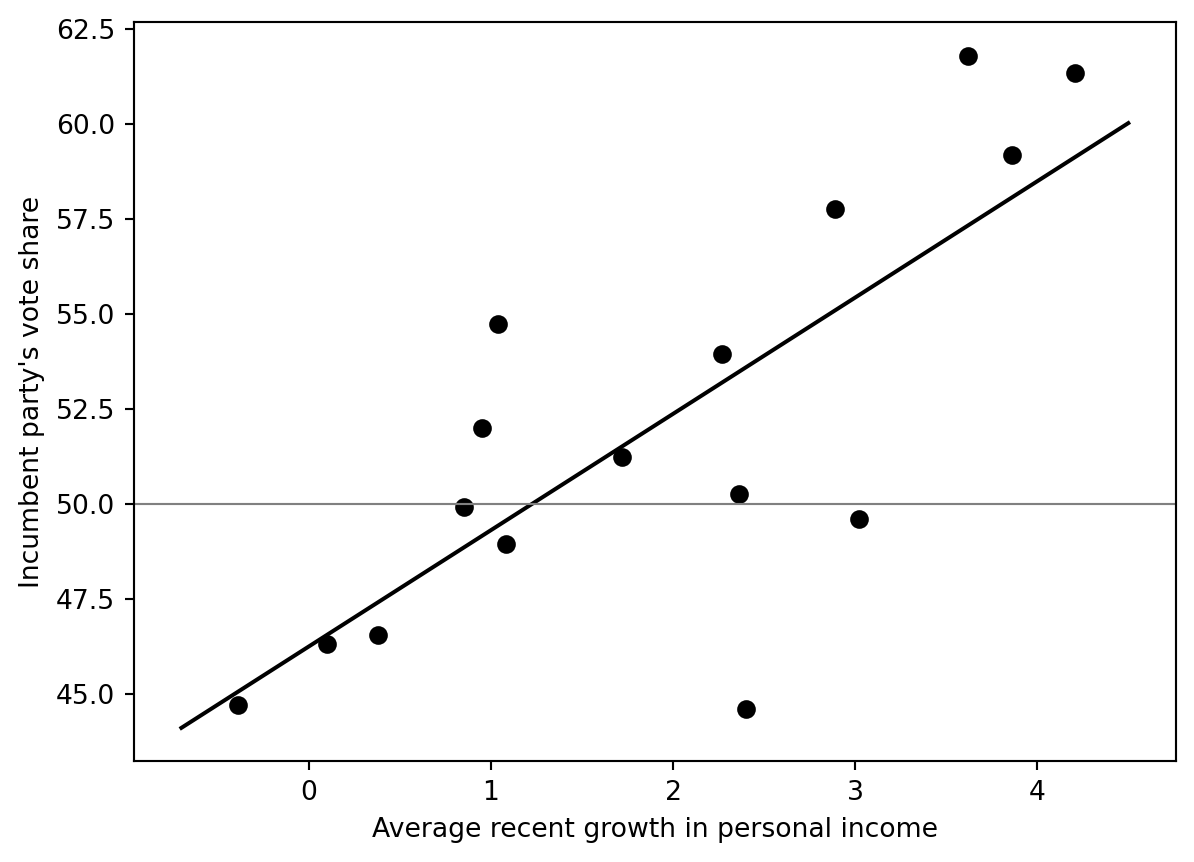
This page fits the incumbent-party vote regression with lapylace, matching the original Bayesian linear-regression target.
Setup
hibbs = pd.read_table(root / "ElectionsEconomy/data/hibbs.dat", sep=r"\s+")
hibbs.head()| year | growth | vote | inc_party_candidate | other_candidate | |
|---|---|---|---|---|---|
| 0 | 1952 | 2.40 | 44.60 | Stevenson | Eisenhower |
| 1 | 1956 | 2.89 | 57.76 | Eisenhower | Stevenson |
| 2 | 1960 | 0.85 | 49.91 | Nixon | Kennedy |
| 3 | 1964 | 4.21 | 61.34 | Johnson | Goldwater |
| 4 | 1968 | 3.02 | 49.60 | Humphrey | Nixon |
fit = fit_glm("vote ~ growth", hibbs, seed=17701, prior_scale=10, intercept_scale=100, aux_scale=10)
coef = coef_medians(fit)
fit.summary(["alpha", "beta", "sigma"]) | Mean | MCSE | StdDev | 5% | 50% | 95% | N_Eff | N_Eff/s | R_hat | |
|---|---|---|---|---|---|---|---|---|---|
| alpha | 46.33050 | 0.089919 | 1.819120 | 43.32570 | 46.36640 | 49.25970 | 409.2820 | 22737.90000 | 1.00371 |
| beta[1] | 3.02169 | 0.037608 | 0.762204 | 1.77057 | 3.03201 | 4.27065 | 410.7470 | 22819.30000 | 1.00520 |
| sigma | 3.98695 | 0.037430 | 0.814850 | 2.78476 | 3.92088 | 5.44362 | 473.8723 | 26326.23866 | 1.00149 |
grid = pd.DataFrame({"growth": np.linspace(hibbs.growth.min(), hibbs.growth.max(), 100)})
pred = fit.posterior_epred(grid)
fig, ax = plt.subplots()
ax.scatter(hibbs.growth, hibbs.vote, color="black")
ax.plot(grid.growth, pred.mean(axis=0), color="black")
ax.fill_between(grid.growth, np.quantile(pred,.1,axis=0), np.quantile(pred,.9,axis=0), color="0.85")
ax.set_xlabel("Economic growth")
ax.set_ylabel("Incumbent-party vote")
Text(0, 0.5, 'Incumbent-party vote')