Elections Economy: uncertainty in the regression line

Source: ElectionsEconomy/hills.Rmd

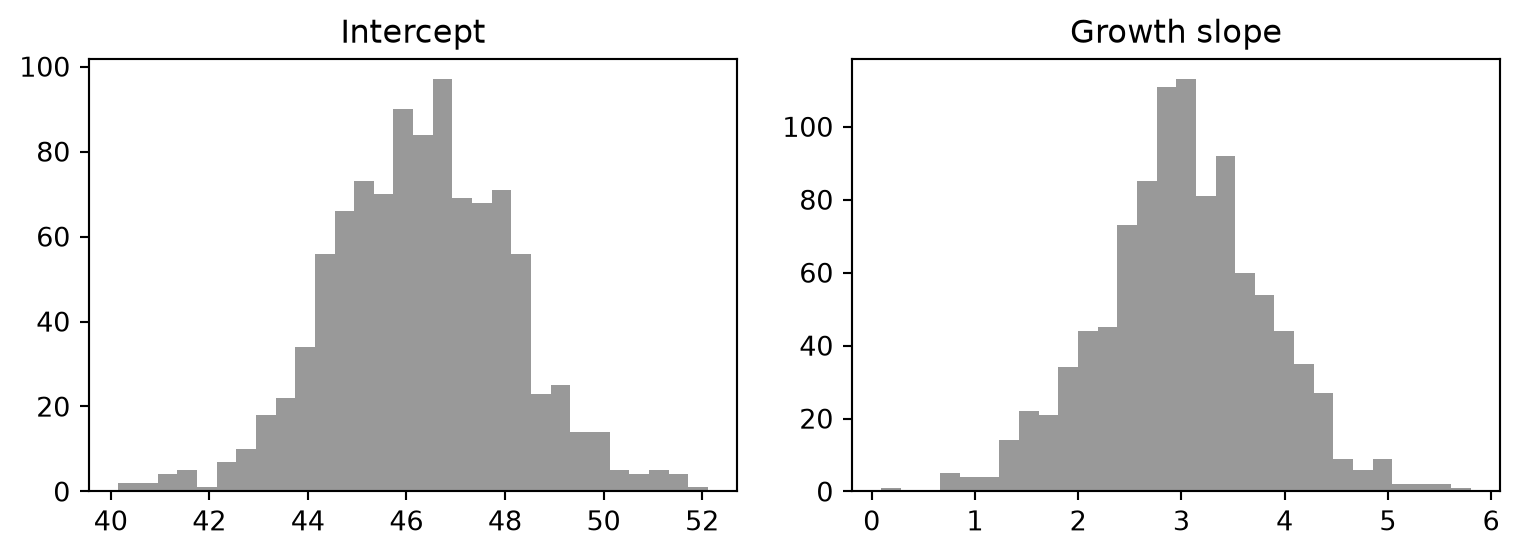
This page visualizes uncertainty in the intercept and slope of the Hibbs election-economy regression. The R version combines least squares summaries with posterior draws from stan_glm under a flat prior. In this Python port, statsmodels gives the least-squares fit and we draw from the large-sample Gaussian approximation to the joint distribution of the coefficients.

Setup and data

Code
from pathlib import Path
import numpy as np
import pandas as pd
import matplotlib.pyplot as plt
import statsmodels.formula.api as smf
from scipy.stats import multivariate_normal

root = Path("../../ROS-Examples")
hibbs = pd.read_csv(root / "ElectionsEconomy/data/hibbs.dat", sep=r"\s+")
rng = np.random.default_rng(7007)
hibbs.head()
year growth vote inc_party_candidate other_candidate
0 1952 2.40 44.60 Stevenson Eisenhower
1 1956 2.89 57.76 Eisenhower Stevenson
2 1960 0.85 49.91 Nixon Kennedy
3 1964 4.21 61.34 Johnson Goldwater
4 1968 3.02 49.60 Humphrey Nixon

Least squares fit

Code
model = smf.ols("vote ~ growth", data=hibbs).fit()
model.summary()
OLS Regression Results
Dep. Variable: vote R-squared: 0.580
Model: OLS Adj. R-squared: 0.550
Method: Least Squares F-statistic: 19.32
Date: Sun, 31 May 2026 Prob (F-statistic): 0.000610
Time: 23:02:04 Log-Likelihood: -42.839
No. Observations: 16 AIC: 89.68
Df Residuals: 14 BIC: 91.22
Df Model: 1
Covariance Type: nonrobust
coef std err t P>|t| [0.025 0.975]
Intercept 46.2476 1.622 28.514 0.000 42.769 49.726
growth 3.0605 0.696 4.396 0.001 1.567 4.554
Omnibus: 5.392 Durbin-Watson: 2.379
Prob(Omnibus): 0.067 Jarque-Bera (JB): 2.828
Skew: -0.961 Prob(JB): 0.243
Kurtosis: 3.738 Cond. No. 4.54


Notes:
[1] Standard Errors assume that the covariance matrix of the errors is correctly specified.
Code
coef = model.params[["Intercept", "growth"]].to_numpy()
cov = model.cov_params().loc[["Intercept", "growth"], ["Intercept", "growth"]].to_numpy()
se = model.bse[["Intercept", "growth"]].to_numpy()
pd.DataFrame({"estimate": coef, "std_err": se}, index=["a", "b"])
estimate std_err
a 46.247648 1.621931
b 3.060528 0.696274

Likelihood for intercept and slope

For a Gaussian regression with residual variance fixed at its estimate, the likelihood for (a, b) is proportional to a bivariate normal density centered at the least-squares estimate.

Code
a_grid = np.linspace(coef[0] - 4 * se[0], coef[0] + 4 * se[0], 80)
b_grid = np.linspace(coef[1] - 4 * se[1], coef[1] + 4 * se[1], 80)
A, B = np.meshgrid(a_grid, b_grid, indexing="ij")
pos = np.dstack([A, B])
Z = multivariate_normal(mean=coef, cov=cov).pdf(pos)
Z = Z / Z.max()

fig = plt.figure(figsize=(7, 5))
ax = fig.add_subplot(111, projection="3d")
ax.plot_surface(A, B, Z, cmap="Greys", linewidth=0, alpha=0.85)
ax.set_xlabel("a")
ax.set_ylabel("b")
ax.set_zlabel("relative likelihood")
ax.set_title("likelihood, p(y | a, b)")
Text(0.5, 0.92, 'likelihood, p(y | a, b)')

Estimate plus one-standard-error cross

Code
fig, ax = plt.subplots(figsize=(5, 5))
ax.set_xlim(a_grid.min(), a_grid.max())
ax.set_ylim(b_grid.min(), b_grid.max())
ax.plot([coef[0], coef[0]], [coef[1] - se[1], coef[1] + se[1]], color="0.25")
ax.plot([coef[0] - se[0], coef[0] + se[0]], [coef[1], coef[1]], color="0.25")
ax.scatter([coef[0]], [coef[1]], color="black", zorder=3)
ax.set_xlabel("a")
ax.set_ylabel("b")
ax.set_title("estimate +/- 1 standard error")
Text(0.5, 1.0, 'estimate +/- 1 standard error')

Joint covariance ellipse

Code
def covariance_ellipse(mean, cov, radius=1.0, n=400):
    theta = np.linspace(0, 2 * np.pi, n)
    circle = np.column_stack([np.cos(theta), np.sin(theta)])
    vals, vecs = np.linalg.eigh(cov)
    transform = vecs @ np.diag(np.sqrt(vals))
    return mean + radius * circle @ transform.T

ell_1 = covariance_ellipse(coef, cov, radius=1)
ell_2 = covariance_ellipse(coef, cov, radius=2)

fig, ax = plt.subplots(figsize=(5, 5))
ax.plot(ell_1[:, 0], ell_1[:, 1], color="black", label="1 sd ellipse")
ax.plot(ell_2[:, 0], ell_2[:, 1], color="0.5", linestyle="--", label="2 sd ellipse")
ax.scatter([coef[0]], [coef[1]], color="black")
ax.set_xlabel("a")
ax.set_ylabel("b")
ax.set_title("joint covariance of (a, b)")
ax.legend(frameon=False)

The tilted ellipse is the key display: intercept and slope are negatively correlated because the fitted line can pivot through the observed range of growth.

Approximate posterior draws with a flat prior

Code
draws = rng.multivariate_normal(coef, cov, size=4000)
draws_df = pd.DataFrame(draws, columns=["a", "b"])
draws_df.describe(percentiles=[0.05, 0.5, 0.95])
a b
count 4000.000000 4000.000000
mean 46.240101 3.059752
std 1.632300 0.687258
min 40.670756 0.603507
5% 43.575850 1.945988
50% 46.247769 3.062827
95% 48.899842 4.186674
max 54.480095 5.411940
Code
fig, ax = plt.subplots(figsize=(5, 5))
ax.scatter(draws_df["a"], draws_df["b"], s=4, alpha=0.2, color="black")
ax.set_xlabel("a")
ax.set_ylabel("b")
ax.set_title("4000 approximate posterior draws of (a, b)")
Text(0.5, 1.0, '4000 approximate posterior draws of (a, b)')

Code
x_grid = np.linspace(hibbs["growth"].min(), hibbs["growth"].max(), 100)
line_draws = draws[:200, 0, None] + draws[:200, 1, None] * x_grid

fig, ax = plt.subplots()
ax.scatter(hibbs["growth"], hibbs["vote"], color="black")
for line in line_draws:
    ax.plot(x_grid, line, color="0.6", alpha=0.15, linewidth=0.8)
ax.plot(x_grid, coef[0] + coef[1] * x_grid, color="black", linewidth=2)
ax.set_xlabel("recent economic growth")
ax.set_ylabel("incumbent party vote share")
ax.set_title("uncertainty in the fitted regression line")
Text(0.5, 1.0, 'uncertainty in the fitted regression line')