import numpy as np
import matplotlib.pyplot as plt
from scipy.stats import norm, lognormHeights and weights: normals, mixtures, and lognormals
Source: CentralLimitTheorem/heightweight.Rmd
This example uses summary histogram counts to show where normal approximations work and where mixtures or transformations are better.
Summary counts
height_counts_women = np.array([80,107,296,695,1612,2680,4645,8201,9948,11733,10270,9942,6181,3990,2131,1154,245,257,0,0,0,0]) * 10339/74167
weight_counts_women = np.array([362,1677,4572,9363,11420,12328,9435,7023,5047,3621,2753,2081,1232,887,2366]) * 10339/74167
height_counts_men = np.array([0,0,0,0,0,0,0,542,668,1221,2175,4213,5535,7980,9566,9578,8867,6716,5019,2745,1464,1263]) * 9983/67552
height_counts = height_counts_women + height_counts_men
heights = np.arange(54, 76)
Histograms from aggregated data
fig, axs = plt.subplots(1, 3, figsize=(11, 3))
axs[0].bar(heights, height_counts_women, width=0.9)
axs[0].set_title("women's heights")
axs[1].bar(heights, height_counts, width=0.9)
axs[1].set_title("all adult heights")
axs[2].bar(np.arange(len(weight_counts_women)), weight_counts_women, width=0.9)
axs[2].set_title("women's weights")
for ax in axs: ax.set_ylabel("count")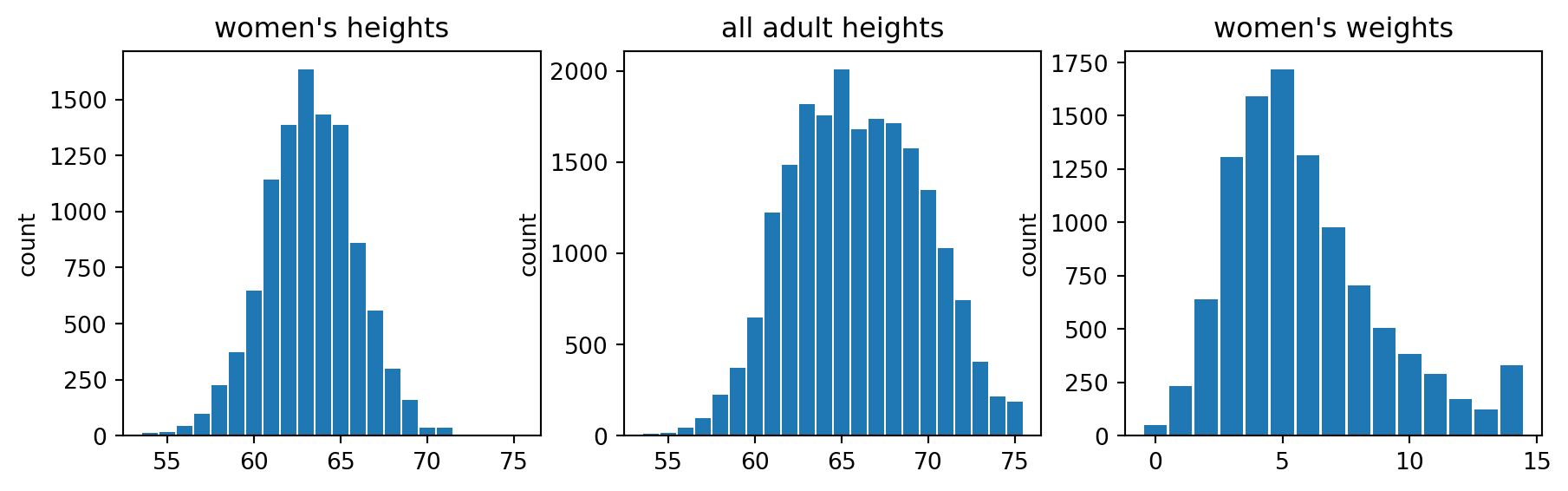
Normal and mixture approximations
x = np.linspace(52, 81, 500)
fig, axs = plt.subplots(1, 3, figsize=(11, 3))
axs[0].plot(x, norm.pdf(x, 63.7, 2.7))
axs[0].set_title("women: approximately normal")
axs[1].plot(x, norm.pdf(x, 69.1, 2.9))
axs[1].set_title("men: approximately normal")
axs[2].plot(x, 0.52*norm.pdf(x, 63.7, 2.7) + 0.48*norm.pdf(x, 69.1, 2.9))
axs[2].set_title("all adults: mixture, not normal")
for ax in axs: ax.set_xlabel("height (inches)")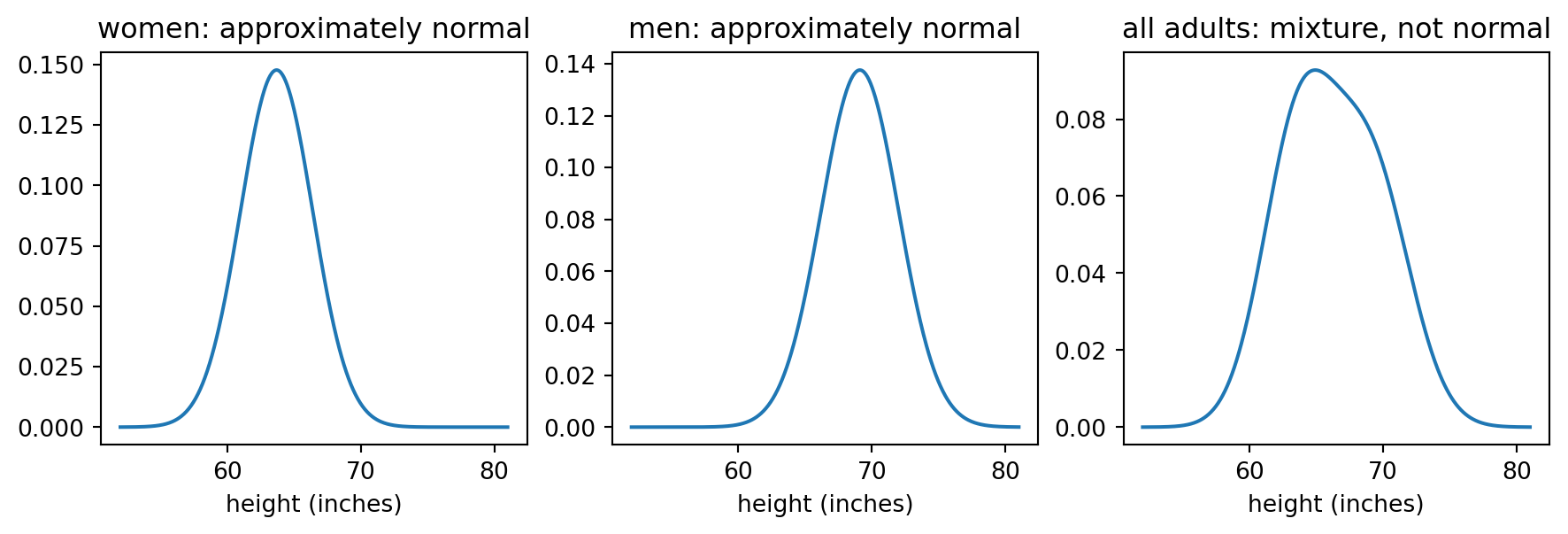
Log weights
x_log = np.linspace(4, 6, 500)
x_w = np.linspace(50, 350, 500)
fig, axs = plt.subplots(1, 2, figsize=(8, 3))
axs[0].plot(x_log, norm.pdf(x_log, 5.13, 0.17))
axs[0].set_title("log weights of men")
axs[1].plot(x_w, lognorm.pdf(x_w, s=0.17, scale=np.exp(5.13)))
axs[1].set_title("weights of men: lognormal")
Text(0.5, 1.0, 'weights of men: lognormal')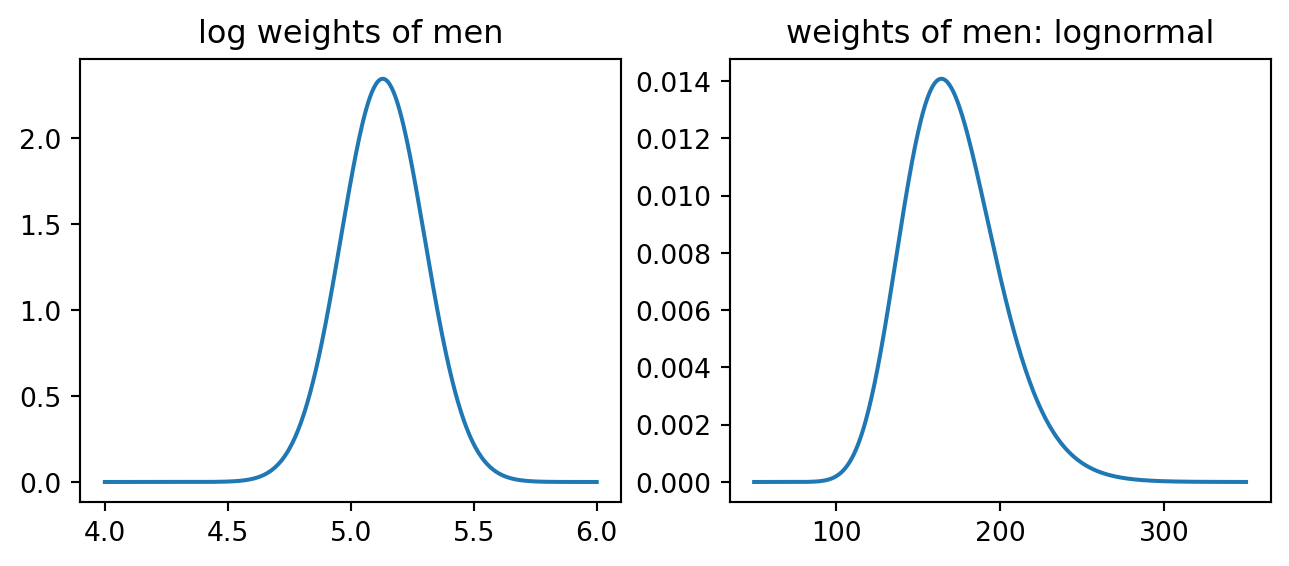
The statistical point is that marginal human heights are close to normal within sex, but the pooled adult distribution is visibly a mixture. Weights are often better approximated after a logarithmic transformation.