Show code
from pathlib import Path

import matplotlib.pyplot as plt
import numpy as np
import pandas as pd

np.set_printoptions(precision=4, suppress=True)


data_dir = Path("../data/ding")Matched-pairs experiments
Matched-pairs experiments replace unrestricted treatment permutations with sign flips inside pairs. The Darwin maize data in the source folder make that logic transparent.
from pathlib import Path
import matplotlib.pyplot as plt
import numpy as np
import pandas as pd
np.set_printoptions(precision=4, suppress=True)
data_dir = Path("../data/ding")zea = pd.read_csv(data_dir / "ZeaMays.csv")
diff = zea["diff"].to_numpy(dtype=float)
n_pairs = diff.size
tau_hat = diff.mean()
se_hat = diff.std(ddof=1) / np.sqrt(n_pairs)
sign_patterns = np.array(
np.meshgrid(*([np.array([-1.0, 1.0])] * n_pairs), indexing="ij")
).reshape(n_pairs, -1).T
randomization_dist = sign_patterns @ np.abs(diff) / n_pairs
one_sided_pvalue = np.mean(randomization_dist >= tau_hat)
two_sided_pvalue = np.mean(np.abs(randomization_dist) >= abs(tau_hat))
pd.DataFrame(
{
"estimate": [tau_hat],
"se": [se_hat],
"one_sided_randomization_pvalue": [one_sided_pvalue],
"two_sided_randomization_pvalue": [two_sided_pvalue],
}
)| estimate | se | one_sided_randomization_pvalue | two_sided_randomization_pvalue | |
|---|---|---|---|---|
| 0 | 2.616667 | 1.218195 | 0.026337 | 0.052673 |
fig, ax = plt.subplots(figsize=(6, 4))
ax.hist(randomization_dist, bins=45, alpha=0.75)
ax.axvline(tau_hat, color="black", linestyle="--", linewidth=2.0)
ax.set_xlabel("Matched-pairs average effect under sign flips")
ax.set_ylabel("Count")
ax.set_title("Darwin maize data: exact matched-pairs randomization distribution")
fig.tight_layout()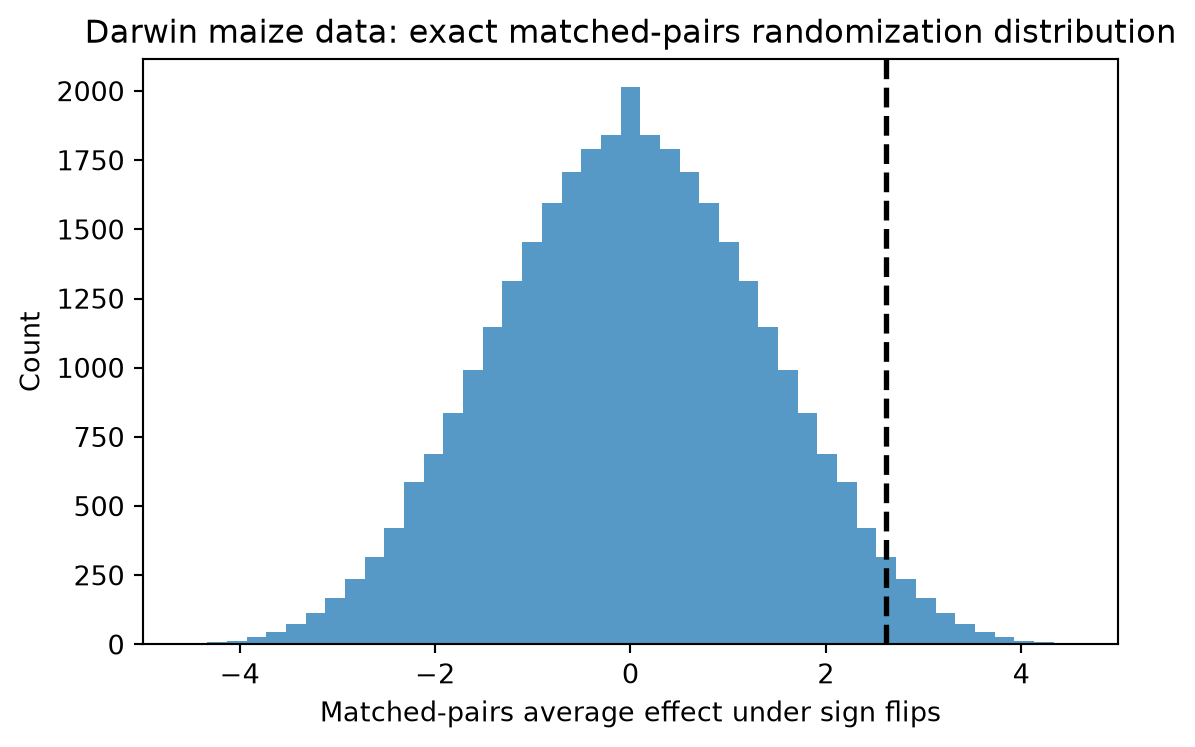
The second worked example in the R script is the Imbens-Rubin television data. Each row is a matched pair. The outcome contrast is diffy, and diffx is a pre-treatment pair difference. The unadjusted paired estimator is the intercept-only regression of diffy; the adjusted estimator is the intercept in a pair-level regression of diffy on diffx.
tv = np.array(
    [
        [12.9, 12.0, 54.6, 60.6],
        [15.1, 12.3, 56.5, 55.5],
        [16.8, 17.2, 75.2, 84.8],
        [15.8, 18.9, 75.6, 101.9],
        [13.9, 15.3, 55.3, 70.6],
        [14.5, 16.6, 59.3, 78.4],
        [17.0, 16.0, 87.0, 84.2],
        [15.8, 20.1, 73.7, 108.6],
    ]
)
diffx = tv[:, 1] - tv[:, 0]
diffy = tv[:, 3] - tv[:, 2]


def intercept_tstat(y, x=None):
    if x is None:
        design = np.ones((len(y), 1))
    else:
        design = np.column_stack([np.ones(len(y)), x])
    beta, *_ = np.linalg.lstsq(design, y, rcond=None)
    resid = y - design @ beta
    sigma2 = float(resid @ resid) / (len(y) - design.shape[1])
    cov = sigma2 * np.linalg.inv(design.T @ design)
    return float(beta[0]), float(np.sqrt(cov[0, 0])), float(beta[0] / np.sqrt(cov[0, 0]))


unadj_est, unadj_se, unadj_t = intercept_tstat(diffy)
adj_est, adj_se, adj_t = intercept_tstat(diffy, diffx)

tv_signs = np.array(np.meshgrid(*([np.array([-1.0, 1.0])] * len(diffy)), indexing="ij")).reshape(len(diffy), -1).T
tv_tstats = np.zeros((tv_signs.shape[0], 2))
for i, signs in enumerate(tv_signs):
    tv_tstats[i, 0] = intercept_tstat(diffy * signs)[2]
    tv_tstats[i, 1] = intercept_tstat(diffy * signs, diffx * signs)[2]

pd.DataFrame(
    {
        "estimate": [unadj_est, adj_est],
        "se": [unadj_se, adj_se],
        "t": [unadj_t, adj_t],
        "studentized_FRT_pvalue": [
            np.mean(np.abs(tv_tstats[:, 0]) >= abs(unadj_t)),
            np.mean(np.abs(tv_tstats[:, 1]) >= abs(adj_t)),
        ],
    },
    index=["Unadjusted pair mean", "Adjusted for pair-level covariate"],
)| estimate | se | t | studentized_FRT_pvalue | |
|---|---|---|---|---|
| Unadjusted pair mean | 13.425000 | 4.636337 | 2.895605 | 0.031250 |
| Adjusted for pair-level covariate | 8.994303 | 1.409610 | 6.380702 | 0.007812 |
fig, axes = plt.subplots(1, 2, figsize=(10, 4))
for ax, column, observed, title in [
    (axes[0], 0, unadj_t, "Unadjusted studentized statistic"),
    (axes[1], 1, adj_t, "Covariate-adjusted studentized statistic"),
]:
    ax.hist(tv_tstats[:, column], bins=35, alpha=0.75)
    ax.axvline(observed, color="black", linestyle="--", linewidth=2.0)
    ax.axvline(-observed, color="black", linestyle=":", linewidth=1.5)
    ax.set_title(title)
    ax.set_xlabel("Sign-flip t statistic")
fig.tight_layout()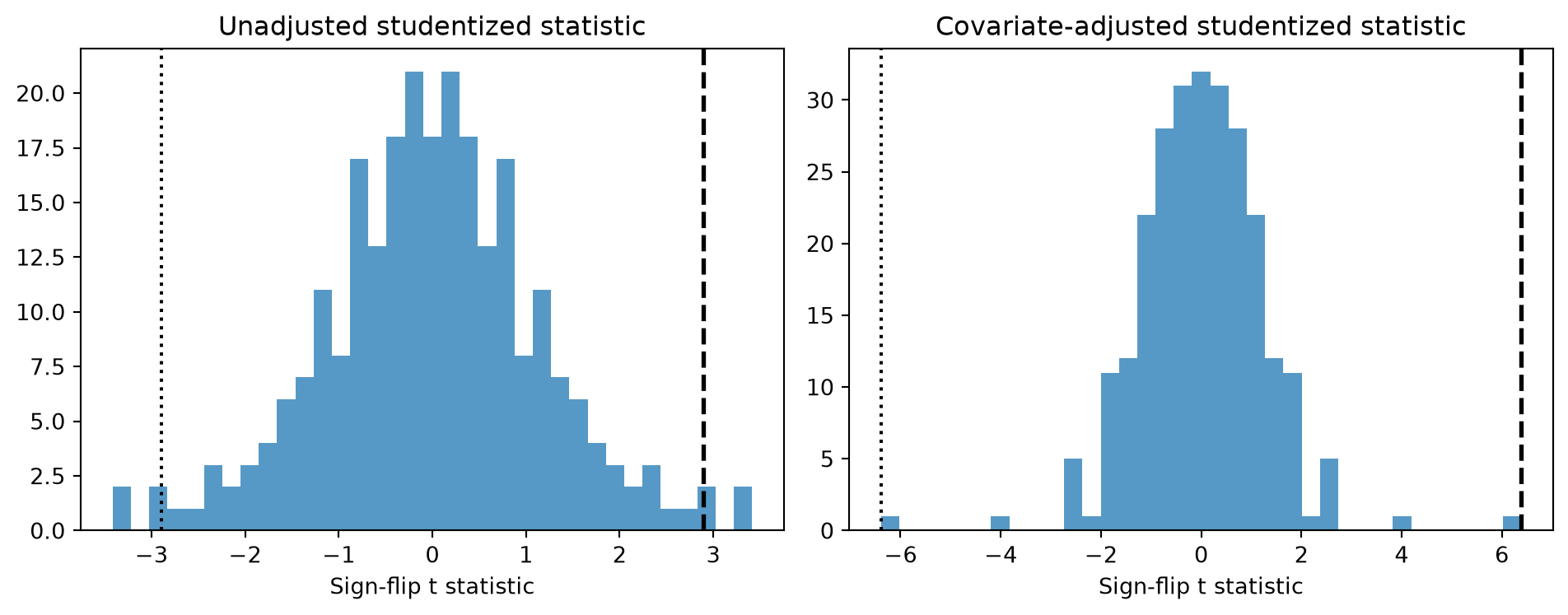
Once the pairs are fixed, the experiment is no longer a general permutation problem. The admissible treatment reallocations are just the within-pair sign changes. The mean pair difference is the natural unadjusted estimator, and pair-level regression adjustment is still tested against the same sign-flip assignment mechanism.