Robust Smooth Optimization Without Extra Dependencies

BFGS safeguards, dense trust regions and likelihood-score curvature

1 Purpose

Smooth econometric criteria can fail numerically because of coordinate scaling, inaccurate curvature or an unreliable trial step. This experiment evaluates three changes to CrabbyMetrics’ generic optimization interface: safeguarded BFGS/L-BFGS, a dense exact-Hessian trust-region method, and BHHH likelihood-score curvature. These optimizer additions are unreleased development APIs and require a source build of the proposed branch. The numerical work is implemented in Rust using the existing dependency stack; the runtime Python requirement remains NumPy. Native estimator defaults and statistical covariance calculations are unchanged.

The six unconstrained families and their 72 size/stress/seed instances match the econometric optimizer comparison. Synthetic control remains on its existing constrained solver. The reference solutions here are independently computed from residual-form least squares and SciPy’s optimization routines; GALAHAD is not a dependency of this experiment. Timings below are fresh measurements of the proposed implementations, not the historical GALAHAD measurements.

2 The optimizer contracts

2.1 Safeguarded BFGS and L-BFGS

The original positional calls continue to work. tolerance is the gradient threshold unless gtol is explicitly supplied. The independent relative cost-stagnation threshold ftol defaults to zero, disabling that stop. A small cost change with a large gradient returns success=False.

Strong-Wolfe bracketing and bisection zoom reject nonfinite numerical trials. Python exceptions and malformed arrays propagate. Degenerate curvature updates are skipped, and an unusable curvature direction is reset. BFGS retains a dense inverse approximation; L-BFGS keeps seven correction pairs. Their final public objective and gradient are evaluated at the actual returned vector.

2.2 Dense trust regions

The step minimizes g's+s'Hs/2 subject to \|s\|\le\Delta. A spectral solve finds the curvature shift, including the hard case where a negative-curvature direction is orthogonal to the gradient. Agreement between actual and predicted reduction controls acceptance and the radius. Small gradients at strict saddles do not count as successful termination. This is a native dense implementation, with O(p^2) storage and O(p^3) eigendecomposition; it does not claim all of GALAHAD TRU’s sparse, iterative or production safeguards.

2.3 BHHH

For a mean negative log likelihood, the gradient and curvature are g=n^{-1}\sum_i s_i and C=n^{-1}\sum_i s_i s_i', where the rows of scores are negative-log-likelihood gradients. reduction="sum" uses sums instead. BHHH solves a damped positive-curvature system and uses the same strong-Wolfe step acceptance. The information identity motivates this curvature at a correctly specified truth; it need not resemble the observed Hessian far from an optimum.

For a memory-bounded alternative, score_stats(theta) returns (score_sum, outer_sum, n_observations) accumulated over batches. These are sums before the chosen reduction. An objective penalty belongs in fun and is added to derivatives through the paired penalty_grad and penalty_hess callbacks; it is not inserted into each observation’s score. The numerical damping is not an inferential covariance estimator.

2.4 Scaling and diagnostic interpretation

x_scale defines x=\operatorname{diag}(\texttt{x\_scale})z. The solver’s optimality is \|\nabla_z f\|_\infty; jac and grad_norm remain in original coordinates. Scaling changes the stopping metric and trust-region geometry. It must be reported explicitly. The scaled L-BFGS run below uses reciprocal regressor RMS values and is a separate configuration.

All four methods retain the original result keys and additionally expose the final gradient, evaluation counts, rejected trials and applicable reset/skip counts. Budget exhaustion and stagnation return a finite diagnostic iterate with success=False; invalid initial data and callback errors raise.

3 Experimental design

Each family has two sizes (2,000/8 and 20,000/24 observations/coefficients), three stresses and two simulation seeds. OLS/ridge vary collinearity, logit varies signal strength, Poisson changes regressor units, IV/GMM weakens an instrument, and NLS changes the starting point. BHHH covers the five likelihood families and has a 60-instance denominator. For Gaussian criteria it uses known simulation variance; the objective and deterministic penalty are normalized consistently with the individual likelihood scores.

Each applicable configuration has an untimed diagnostic fit and three timed fits with tracing disabled. Timed configuration order is shuffled within each instance. Reference construction and independent rescoring are outside the clock; criterion preparation, callbacks and final solver diagnostics are inside. All runs use one numerical thread, gtol=1e-8, a 1,000-iteration limit and a 10-second callback deadline. BHHH uses the batched-statistics interface.

The external pass rule is shared across methods: relative objective excess at most 10^{-8} and regressor-RMS-scaled gradient at most 10^{-6}, evaluated from the original criterion. It is distinct from native stopping, particularly when likelihood normalization or coordinate scaling differs. An instance passes only if all three repetitions pass. Repetition medians describe a single named configuration on a single instance; timing summaries include accepted instances only, with the denominator shown.

Imports, thread limits and experiment constants
import os
for variable in ["OMP_NUM_THREADS", "OPENBLAS_NUM_THREADS", "MKL_NUM_THREADS",
                 "VECLIB_MAXIMUM_THREADS", "RAYON_NUM_THREADS"]:
    os.environ[variable] = "1"
from pathlib import Path
from time import perf_counter
from importlib import metadata
import json, hashlib, platform
import numpy as np
import pandas as pd
import matplotlib.pyplot as plt
from scipy.special import expit
from scipy.linalg import solve_triangular
from scipy.optimize import minimize, least_squares
from threadpoolctl import threadpool_limits
from IPython.display import display, Markdown
import crabbymetrics as cm
threadpool_limits(1)
FAMILIES = ["OLS", "Ridge", "Logit", "Poisson", "IV-GMM", "NLS", "SCM"]
METHODS = ["BFGS", "L-BFGS", "Trust region", "BHHH", "L-BFGS scaled"]
COLORS = dict(zip(METHODS, ["#355c9a", "#8b5ea4", "#008b8b", "#c34b45", "#799e3f"]))
OUTPUT = Path("data/optimizer-robustness")
OUTPUT.mkdir(parents=True, exist_ok=True)
plt.rcParams.update({"font.size": 10, "axes.spines.top": False, "axes.spines.right": False})
Simulate the original size, stress and seed instances
def make_problem(family, size, level, seed):
    group = 0 if family in ["OLS", "Ridge"] else FAMILIES.index(family)
    rng = np.random.default_rng(20261021 + 100 * group + 10 * size + seed)
    n, p = [(2000, 8), (20000, 24)][size]
    if family == "SCM":
        n, p = [(100, 12), (500, 50)][size]
        factors, loadings = rng.normal(size=(n, 3)), rng.normal(size=(3, p))
        X = factors @ loadings / np.sqrt(3) + [1, .1, .01][level] * rng.normal(size=(n, p))
        beta = np.r_[.2, .3, .5, np.zeros(p - 3)]
        y = X @ beta + .05 * rng.normal(size=n)
        return dict(family=family, X=X, y=y, beta=beta, x0=np.full(p, 1 / p),
                    penalty=np.zeros(p), Z=None)
    features = rng.normal(size=(n, p - 1))
    if family in ["OLS", "Ridge"]:
        Q, _ = np.linalg.qr(features - features.mean(axis=0))
        V, _ = np.linalg.qr(rng.normal(size=(p - 1, p - 1)))
        singular = np.geomspace(1, 1 / [1, 100, 10000][level], p - 1)
        features = np.sqrt(n) * (Q * singular) @ V.T
    X = np.column_stack([np.ones(n), features])
    beta = rng.normal(size=p)
    beta[1:] *= .4 / np.linalg.norm(beta[1:])
    beta[0] = .2
    Z = None
    if family == "Logit":
        beta[1:] *= [1, 4, 12][level] / .4
        y = rng.binomial(1, expit(X @ beta)).astype(float)
    elif family == "Poisson":
        scales = np.r_[1, np.geomspace(1, [1, 100, 10000][level], p - 1)]
        X *= scales
        beta /= scales
        y = rng.poisson(np.exp(X @ beta)).astype(float)
    elif family == "IV-GMM":
        Z = np.column_stack([np.ones(n), rng.normal(size=(n, p + 3))])
        v = rng.normal(size=(n, p - 1))
        strength = np.ones(p - 1)
        strength[0] = [1, .1, .01][level]
        X[:, 1:] = Z[:, 1:p] * strength + v
        y = X @ beta + .7 * v[:, 0] + np.sqrt(1 - .7**2) * rng.normal(size=n)
    elif family == "NLS":
        y = np.exp(X @ beta) + .1 * rng.normal(size=n)
    else:
        y = X @ beta + .25 * rng.normal(size=n)
    penalty = np.r_[0., np.full(p - 1, .01 if family == "Ridge" else 0.)]
    x0 = [0, 4, -6][level] * beta if family == "NLS" else np.zeros(p)
    return dict(family=family, X=np.ascontiguousarray(X), y=y, beta=beta,
                x0=x0, penalty=penalty, Z=Z)
Evaluate criteria, exact gradients and exact Hessians
class Criterion:
    def __init__(self, problem, trace=False, origin=None):
        self.d = problem
        self.kind, self.X, self.y = problem["family"], problem["X"], problem["y"]
        self.n, self.p = self.X.shape
        self.penalty = problem["penalty"]
        self.last = self.value = self.gradient = None
        self.nfg = self.nh = self.nopg = 0
        self.trace = [] if trace else None
        self.origin = perf_counter() if origin is None else origin
        self.scales = np.sqrt(np.mean(self.X**2, axis=0)) if trace else None
        self.deadline = float("inf")
        self.H = None
        if self.kind == "IV-GMM":
            Z = problem["Z"]
            L = np.linalg.cholesky(Z.T @ Z / self.n)
            self.A = solve_triangular(L, Z.T @ self.X / self.n, lower=True)
            self.b = solve_triangular(L, Z.T @ self.y / self.n, lower=True)
        elif self.kind in ["OLS", "Ridge", "SCM"]:
            self.A, self.b = self.X / np.sqrt(self.n), self.y / np.sqrt(self.n)
        if self.kind in ["OLS", "Ridge", "IV-GMM", "SCM"]:
            self.H = self.A.T @ self.A + np.diag(self.penalty)
            self.linear = self.A.T @ self.b
            self.constant = .5 * self.b @ self.b

    @np.errstate(over="ignore", invalid="ignore")
    def fg(self, x):
        if perf_counter() > self.deadline:
            raise TimeoutError("10-second callback budget reached")
        if self.last is None or not np.array_equal(x, self.last):
            self.nfg += 1
            if self.H is not None:
                g = self.H @ x - self.linear
                f = .5 * x @ self.H @ x - self.linear @ x + self.constant
            else:
                eta = self.X @ x
                if self.kind == "Logit":
                    mu = expit(eta)
                    f, residual = np.mean(np.logaddexp(0, eta) - self.y * eta), mu - self.y
                elif self.kind == "Poisson":
                    mu = np.exp(eta)
                    f, residual = np.mean(mu - self.y * eta), mu - self.y
                else:
                    mu = np.exp(eta)
                    f, residual = .5 * np.mean((mu - self.y)**2), mu * (mu - self.y)
                g = self.X.T @ residual / self.n
            self.last, self.value, self.gradient = x.copy(), float(f), g
            if self.trace is not None:
                self.trace.append(dict(evaluation=self.nfg, elapsed=perf_counter() - self.origin,
                                       objective=float(f), scaled_gradient=float(np.max(np.abs(g / self.scales))),
                                       fw_gap=float(g @ x - g.min()) if self.kind == "SCM" else np.nan,
                                       hessian_evaluations=self.nh, opg_evaluations=self.nopg))
        return self.value, self.gradient

    @np.errstate(over="ignore", invalid="ignore")
    def hessian(self, x):
        self.nh += 1
        if self.H is not None:
            return self.H
        eta = self.X @ x
        if self.kind == "Logit":
            mu = expit(eta)
            weights = mu * (1 - mu)
        else:
            mu = np.exp(eta)
            weights = mu if self.kind == "Poisson" else mu * (2 * mu - self.y)
        return self.X.T @ (weights[:, None] * self.X) / self.n

    def fun(self, x):
        return self.fg(x)[0]

    def grad(self, x):
        return self.fg(x)[1]

    @np.errstate(over="ignore", invalid="ignore")
    def opg(self, x):
        self.nopg += 1
        eta = self.X @ x
        if self.kind == "Logit":
            scores = (expit(eta) - self.y)[:, None] * self.X
            variance = 1.
        elif self.kind == "Poisson":
            scores = (np.exp(eta) - self.y)[:, None] * self.X
            variance = 1.
        else:
            mu = np.exp(eta) if self.kind == "NLS" else eta
            derivative = mu if self.kind == "NLS" else np.ones(self.n)
            scores = (derivative * (mu - self.y))[:, None] * self.X
            variance = .1**2 if self.kind == "NLS" else .25**2
        return scores.T @ scores / (self.n * variance) + np.diag(self.penalty)
Compute independent sample optima and externally score returned vectors
def reference_solution(d):
    c = Criterion(d)
    scales = np.sqrt(np.mean(d["X"]**2, axis=0))
    if d["family"] in ["OLS", "Ridge", "IV-GMM"]:
        A = np.vstack([c.A, np.diag(np.sqrt(d["penalty"]))])
        b = np.r_[c.b, np.zeros(c.p)]
        x = np.linalg.lstsq(A, b, rcond=None)[0]
    elif d["family"] == "SCM":
        result = minimize(c.fun, d["x0"], jac=c.grad, method="SLSQP",
                          bounds=[(0, 1)] * c.p,
                          constraints={"type": "eq", "fun": lambda x: x.sum() - 1,
                                       "jac": lambda x: np.ones(c.p)},
                          options={"ftol": 1e-14, "maxiter": 3000})
        x = result.x
    elif d["family"] == "NLS":
        X, y = d["X"], d["y"]
        fits = [least_squares(lambda x: (np.exp(X @ x) - y) / np.sqrt(c.n), start,
                             jac=lambda x: np.exp(X @ x)[:, None] * X / np.sqrt(c.n),
                             ftol=1e-12, xtol=1e-12, gtol=1e-12, max_nfev=2000)
                for start in [np.zeros(c.p), d["beta"], d["x0"]]]
        x = min(fits, key=lambda fit: np.dot(fit.fun, fit.fun)).x
    else:
        result = minimize(lambda z: c.fun(z / scales), np.zeros(c.p),
                          jac=lambda z: c.grad(z / scales) / scales,
                          hess=lambda z: c.hessian(z / scales) / np.outer(scales, scales),
                          method="trust-exact", options={"gtol": 1e-11, "maxiter": 1000})
        x = result.x / scales
    return x

@np.errstate(over="ignore", invalid="ignore")
def evaluate_solution(d, x, ref):
    c = Criterion(d)
    f, g = c.fg(x)
    fref = c.fun(ref)
    # Score quadratic fits from residuals, independently of the Gram-form callback.
    if c.H is not None:
        residual, reference_residual = c.A @ x - c.b, c.A @ ref - c.b
        f = .5 * (residual @ residual + np.dot(c.penalty, x**2))
        fref = .5 * (reference_residual @ reference_residual + np.dot(c.penalty, ref**2))
        g = c.A.T @ residual + c.penalty * x
    scale = np.sqrt(np.mean(d["X"]**2, axis=0))
    score = np.max(np.abs(g / scale))
    gap = (f - fref) / max(1, abs(fref))
    feasibility = max(0., -float(x.min()), abs(float(x.sum()) - 1)) if c.kind == "SCM" else 0.
    fw_gap = float(g @ x - g.min()) if c.kind == "SCM" else np.nan
    passed = (fw_gap <= 1e-7 and feasibility <= 1e-8) if c.kind == "SCM" else (gap <= 1e-8 and score <= 1e-6)
    passed = bool(passed and np.isfinite(f) and np.isfinite(score) and np.all(np.isfinite(x)))
    eta, eta_ref = d["X"] @ x, d["X"] @ ref
    transform = expit if c.kind == "Logit" else np.exp if c.kind in ["Poisson", "NLS"] else lambda a: a
    pred, predref = transform(eta), transform(eta_ref)
    return dict(objective=f, objective_gap=gap, scaled_gradient=score,
                fw_gap=fw_gap, feasibility=feasibility, accepted=passed,
                coefficient_error=np.linalg.norm(x - ref) / max(1, np.linalg.norm(ref)),
                prediction_error=np.sqrt(np.mean((pred - predref)**2)) / max(1, np.sqrt(np.mean(predref**2))))
Likelihood score statistics and a direct call to each public optimizer
def run_fit(d, method, tracing=False):
    started = perf_counter()
    c = Criterion(d, trace=tracing, origin=started)
    c.deadline = started + 10.0
    options = dict(max_iterations=1000, gtol=1e-8)
    variance = .1**2 if c.kind == "NLS" else .25**2 if c.kind in ["OLS", "Ridge"] else 1.
    if method == "BHHH":
        # Raw score sums and cross-products; Rust applies the mean reduction.
        def score_stats(b):
            total, outer = np.zeros(c.p), np.zeros((c.p, c.p))
            if perf_counter() > c.deadline:
                raise TimeoutError("10-second callback budget reached")
            for begin in range(0, c.n, 4096):
                X, y = c.X[begin:begin+4096], c.y[begin:begin+4096]
                eta = X @ b
                if c.kind == "Logit":
                    scalar = expit(eta) - y
                elif c.kind == "Poisson":
                    scalar = np.exp(eta) - y
                else:
                    mu = np.exp(eta) if c.kind == "NLS" else eta
                    derivative = mu if c.kind == "NLS" else 1.
                    scalar = derivative * (mu - y) / variance
                scores = X * scalar[:, None]
                total += scores.sum(axis=0)
                outer += scores.T @ scores
            return total, outer, c.n
        if np.any(c.penalty):
            options.update(penalty_grad=lambda b: c.penalty * b / variance,
                           penalty_hess=lambda b: np.diag(c.penalty) / variance)
        result = cm.Optimizers.minimize_bhhh(
            lambda b: c.fun(b) / variance, d["x0"], score_stats=score_stats, **options)
    elif method == "Trust region":
        result = cm.Optimizers.minimize_trust_region(c.fun, d["x0"], c.grad, c.hessian, **options)
    else:
        if method == "L-BFGS scaled":
            options["x_scale"] = 1 / np.sqrt(np.mean(d["X"]**2, axis=0))
        solver = cm.Optimizers.minimize_bfgs if method == "BFGS" else cm.Optimizers.minimize_lbfgs
        result = solver(c.fun, d["x0"], c.grad, **options)
    elapsed = perf_counter() - started
    # BHHH returns an NLL; the external evaluator always uses the original criterion.
    return result, elapsed, c.trace
Execute all diagnostic fits and independently check every timed fit
rows, diagnostic_rows, paths = [], [], []
data_hasher = hashlib.sha256()
for family in FAMILIES[:-1]:
    for size in range(2):
        for level in range(3):
            for seed in range(2):
                d = make_problem(family, size, level, seed)
                for key in ["X", "y", "beta", "x0"]:
                    data_hasher.update(np.ascontiguousarray(d[key]).tobytes())
                ref = reference_solution(d)
                assert evaluate_solution(d, ref, ref)["accepted"]
                available = [m for m in METHODS if not (m == "BHHH" and family == "IV-GMM")]
                case = f"{family}-{size}-{level}-{seed}"
                for method in available:
                    try:
                        result, elapsed, trace = run_fit(d, method, tracing=True)
                        checked = evaluate_solution(d, result["x"], ref)
                        diagnostic_rows.append(dict(case=case, family=family, method=method,
                            status=result["status"], native_success=result["success"],
                            parameters=json.dumps(result["x"].tolist()), reference_parameters=json.dumps(ref.tolist()), **checked))
                        if size == 1 and level == 2 and seed == 0:
                            reference_value = Criterion(d).fun(ref)
                            for point in trace:
                                point.update(family=family, method=method,
                                    excess=max(0., (point["objective"]-reference_value)
                                               / max(1., abs(reference_value))))
                                paths.append(point)
                    except Exception as exc:
                        diagnostic_rows.append(dict(case=case, family=family, method=method,
                            accepted=False, native_success=False, status=str(exc)))
                order = [(method, repeat) for method in available for repeat in range(3)]
                np.random.default_rng(20261114 + 100*FAMILIES.index(family) + 10*size + 3*level + seed).shuffle(order)
                for method, repeat in order:
                    record = dict(case=case, family=family, size=size, level=level, seed=seed,
                                  method=method, repeat=repeat)
                    try:
                        result, elapsed, _ = run_fit(d, method)
                        checked = evaluate_solution(d, result["x"], ref)
                        record.update(seconds=elapsed, native_success=result["success"],
                            status=result["status"], nit=result["nit"], nfev=result["nfev"],
                            njev=result["njev"], nhev=result["nhev"], nscorev=result["nscorev"],
                            returned_optimality=result["optimality"], parameters=json.dumps(result["x"].tolist()),
                            reference_parameters=json.dumps(ref.tolist()), **checked)
                    except Exception as exc:
                        record.update(seconds=np.nan, accepted=False, native_success=False,
                                      status=str(exc))
                    rows.append(record)
results = pd.DataFrame(rows)
diagnostics = pd.DataFrame(diagnostic_rows)
traces = pd.DataFrame(paths)
paired = results.groupby(["case", "family", "size", "level", "seed", "method"], as_index=False).agg(
    accepted=("accepted", "all"), native_success=("native_success", "all"),
    seconds=("seconds", "median"), objective_gap=("objective_gap", "max"),
    scaled_gradient=("scaled_gradient", "max"))
for name, frame in [("results", results), ("paired", paired), ("diagnostics", diagnostics), ("traces", traces)]:
    frame.to_csv(OUTPUT / (f"{name}.csv.gz" if name == "traces" else f"{name}.csv"), index=False)
repo = Path.cwd().resolve()
while not (repo / "Cargo.toml").exists() and repo != repo.parent:
    repo = repo.parent
source_hashes = {str(path.relative_to(repo)): hashlib.sha256(path.read_bytes()).hexdigest()
                 for path in [repo / "src/optimizers.rs", *sorted((repo / "src/optimizers").glob("*.rs"))]
                 if path.exists()}
extension = next(Path(cm.__file__).parent.glob("*.so"), Path(cm.__file__))
provenance = dict(source_sha256=source_hashes,
    extension_sha256=hashlib.sha256(extension.read_bytes()).hexdigest(), python=platform.python_version(), platform=platform.platform(),
    versions={name: metadata.version(name) for name in ["crabbymetrics", "numpy", "scipy"]},
    cpu="Apple M4", threads=1, repetitions=3, timed_fits=len(results),
    diagnostic_fits=len(diagnostics), data_sha256=data_hasher.hexdigest())
(OUTPUT / "environment.json").write_text(json.dumps(provenance, indent=2))
973

4 Results

4.1 External accuracy and native termination

Summarize the same-instance accuracy rule and returned stopping flags
summary = paired.groupby("method", sort=False).agg(
    passed=("accepted", "sum"), attempted=("accepted", "size"),
    native_passed=("native_success", "sum"))
summary["passed / attempted"] = summary.passed.astype(str) + " / " + summary.attempted.astype(str)
display(summary[["passed / attempted", "native_passed"]].rename(
    columns={"native_passed": "Native gradient certificate"}))
display(Markdown(f"The experiment completed **{len(results):,} timed fits** and "
                 f"**{len(diagnostics):,} diagnostic fits**. A native certificate and the common "
                 "external rule can differ; neither is silently substituted for the other."))
passed / attempted Native gradient certificate
method
BFGS 72 / 72 72
L-BFGS 65 / 72 61
L-BFGS scaled 70 / 72 70
Trust region 72 / 72 72
BHHH 52 / 60 47

The experiment completed 1,044 timed fits and 348 diagnostic fits. A native certificate and the common external rule can differ; neither is silently substituted for the other.

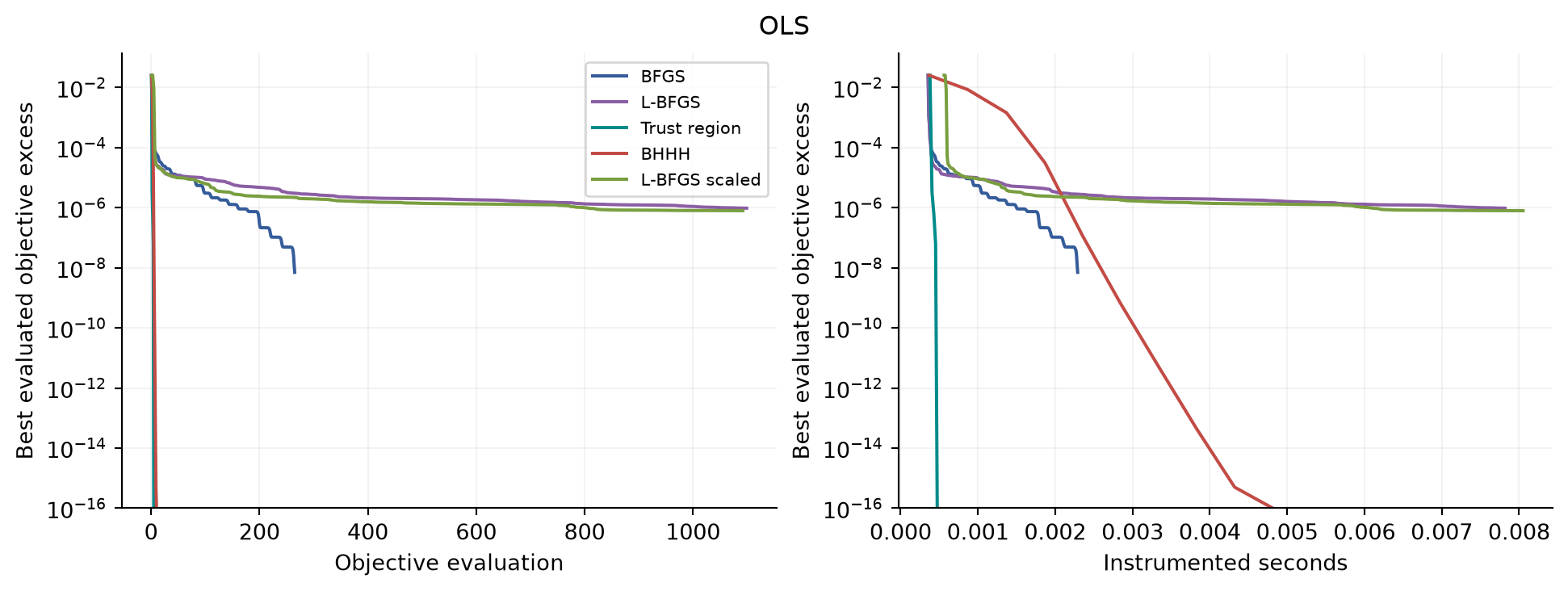
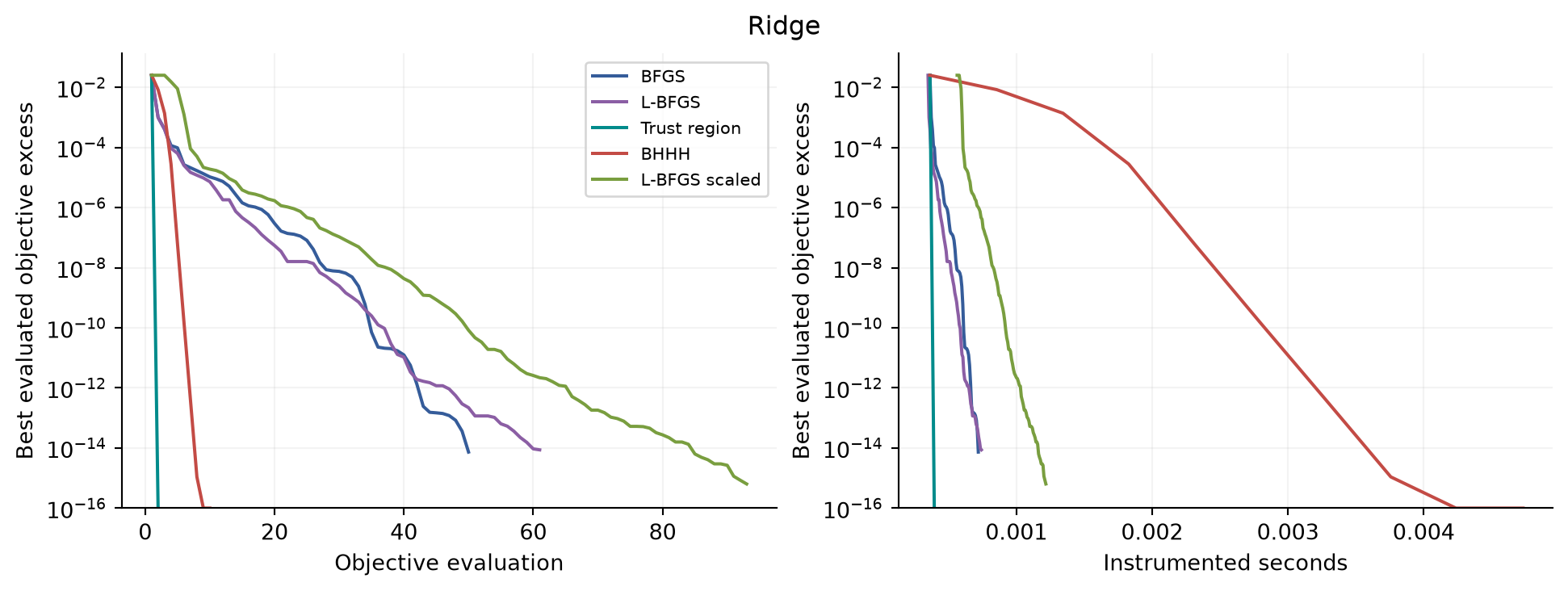
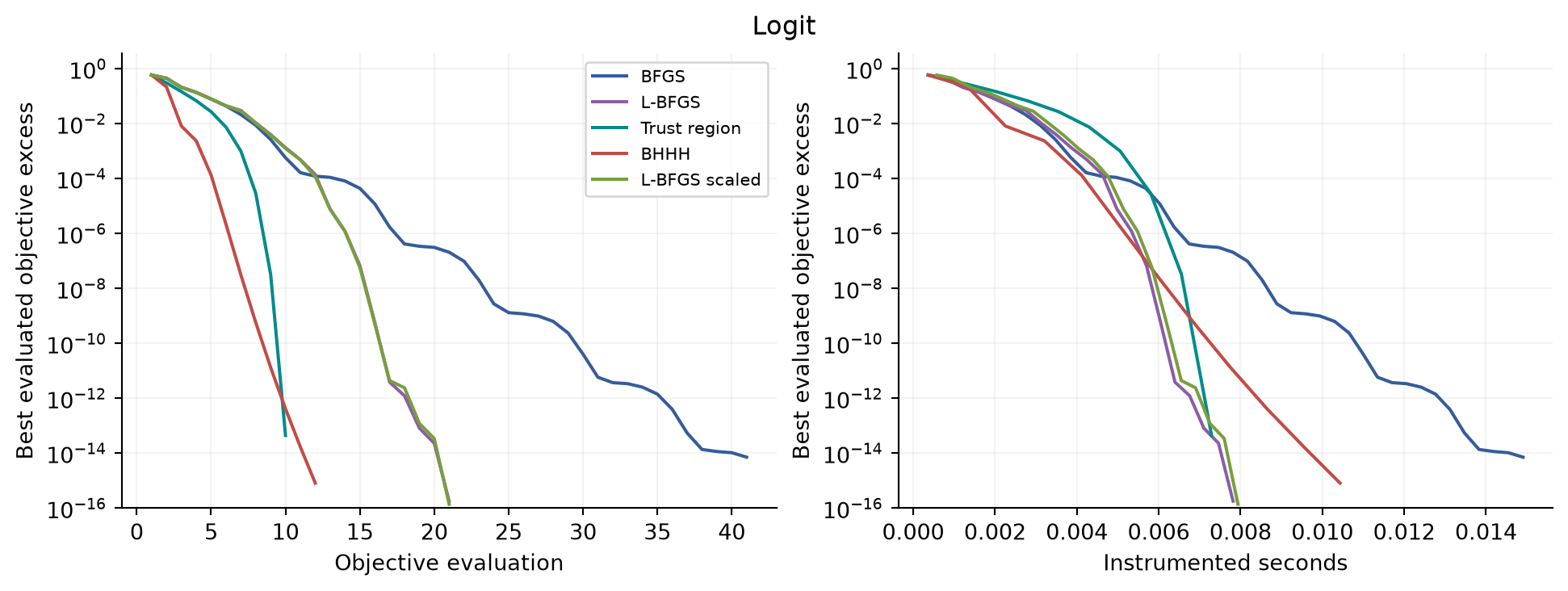
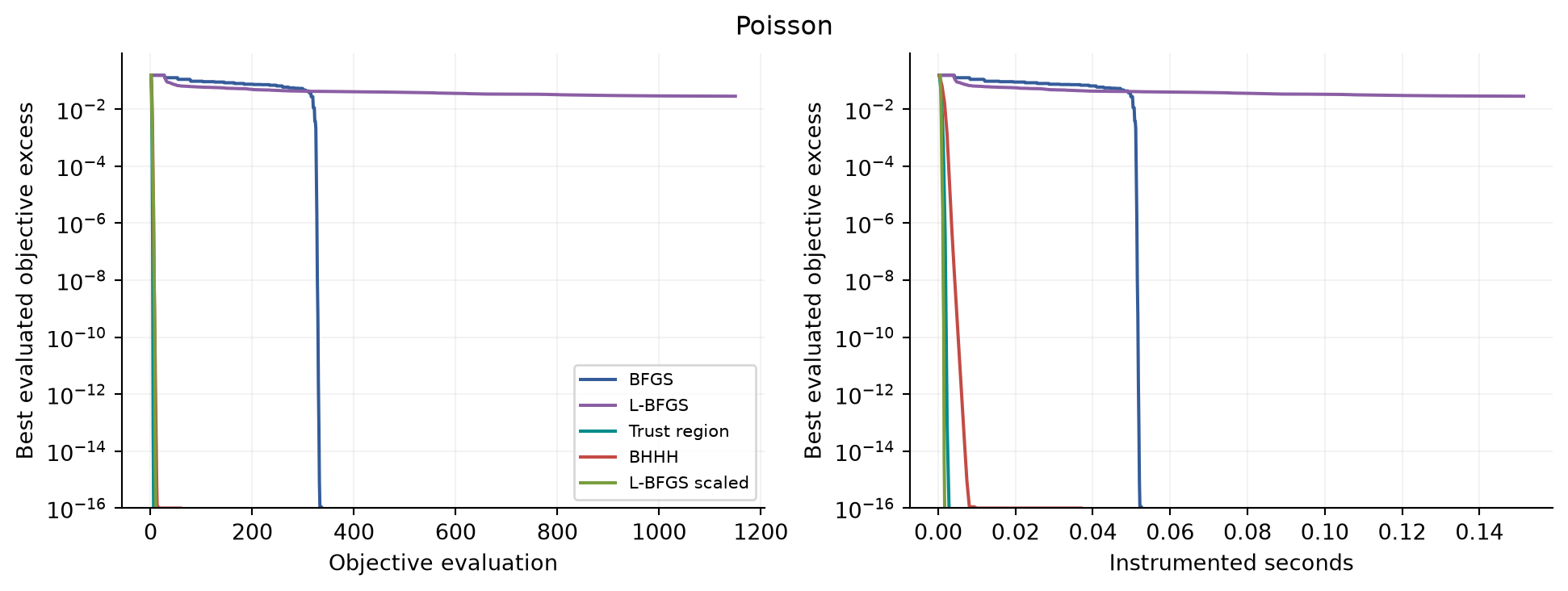
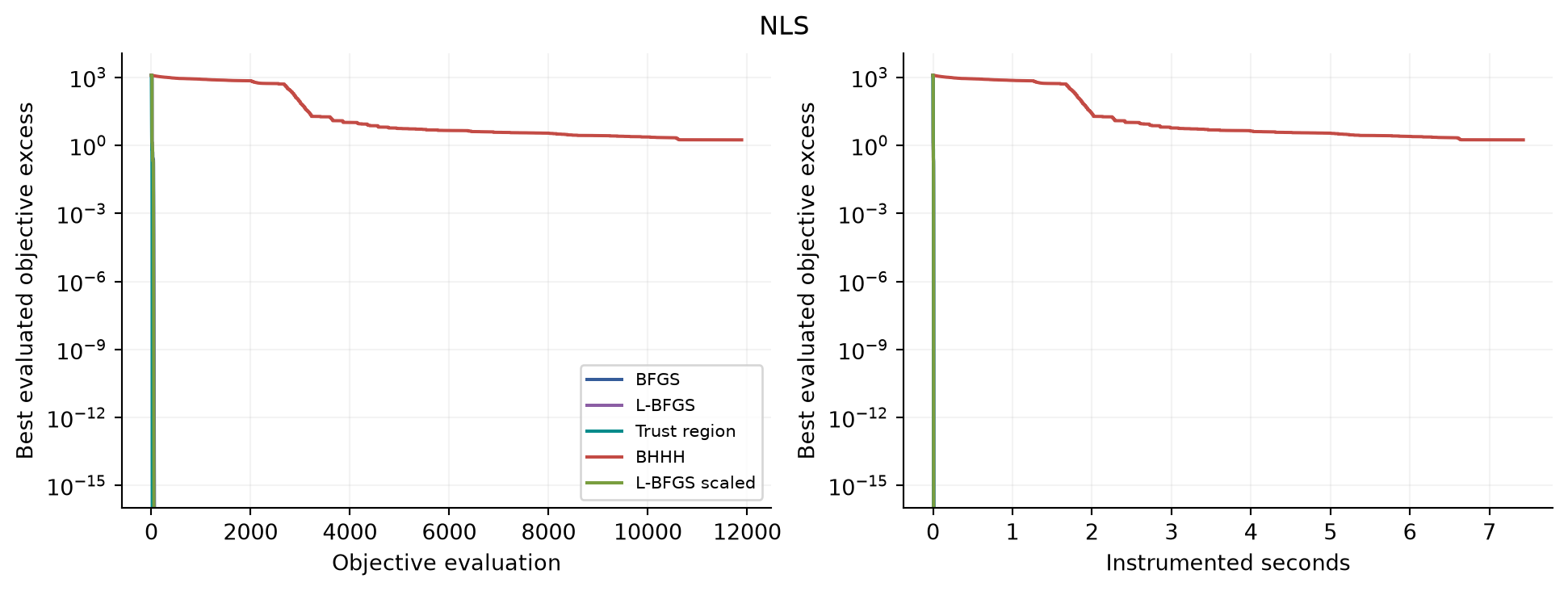
BFGS and the dense trust-region method satisfy the external rule on all 72 instances. Unscaled L-BFGS satisfies it on 65; explicit scaling raises that to 70, recovering all Poisson cases while leaving two ill-conditioned OLS cases. BHHH passes 52 of its 60 likelihood cases: all OLS, ridge, logit and Poisson cases, and four of twelve NLS cases. Its stricter native gradient certificate can fail even after the common external accuracy target is met; both counts are shown.

The stress cases distinguish coordinate scaling, Hessian conditioning and the accuracy of score-based curvature. Explicit scaling can help limited-memory optimization without recovering the directions lost to severe collinearity. BHHH remains a likelihood-specific option whose information-matrix motivation does not guarantee good curvature at a distant nonlinear-least-squares start. The rejected configurations remain in the exported results.

Family-by-family external accuracy counts
counts = paired.assign(pass_count=paired.accepted.astype(int)).pivot_table(
    index="family", columns="method", values="pass_count", aggfunc="sum").reindex(FAMILIES[:-1])
display(counts.astype("Int64"))
method BFGS BHHH L-BFGS L-BFGS scaled Trust region
family
OLS 12 12 9 10 12
Ridge 12 12 12 12 12
Logit 12 12 12 12 12
Poisson 12 12 8 12 12
IV-GMM 12 <NA> 12 12 12
NLS 12 4 12 12 12

Each entry is a count out of twelve. The blank IV/GMM BHHH cell is deliberately inapplicable. The native trust-region implementation should be judged by these observed results and the hard-case tests; success in this small dense suite does not establish equivalence to the full GALAHAD implementation.

4.2 Timing across every estimator family

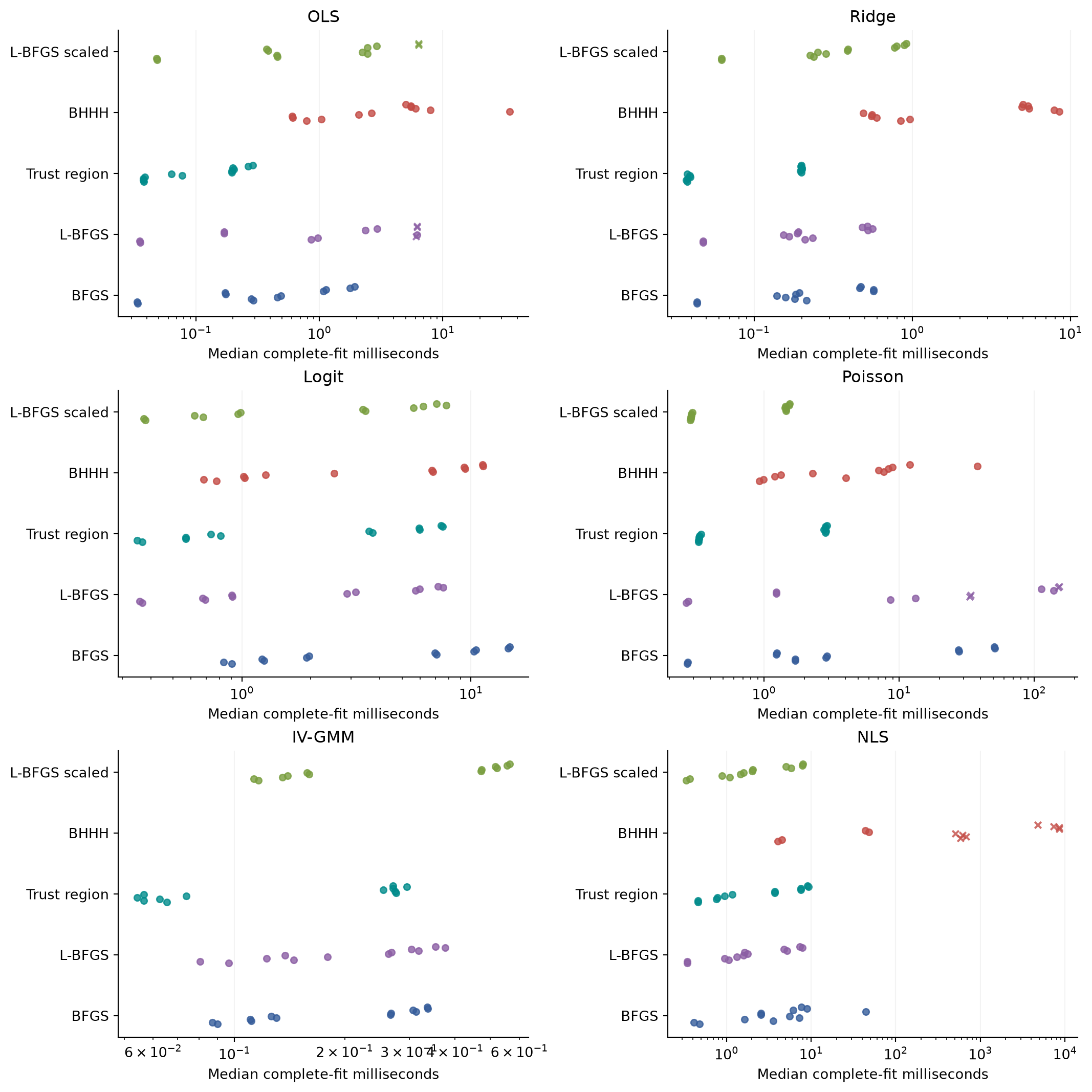
The following figure uses the median of three clean timed repetitions for each method/instance. Filled points pass the common accuracy rule; crosses fail it. Colors distinguish solver configurations. Timings for rejected fits are shown for diagnosis and do not count as accepted speed advantages.

Plot every paired fit time with its independent accuracy flag
fig, axes = plt.subplots(3, 2, figsize=(11, 11), constrained_layout=True)
for ax, family in zip(axes.flat, FAMILIES[:-1]):
    for j, method in enumerate(METHODS):
        subset = paired[(paired.family == family) & (paired.method == method)]
        for index, (_, row) in enumerate(subset.iterrows()):
            ax.scatter(1000*row.seconds, j + .025*(index-5.5), color=COLORS[method],
                       marker="o" if row.accepted else "x", s=22, alpha=.8)
    ax.set(title=family, xscale="log", xlabel="Median complete-fit milliseconds",
           yticks=range(len(METHODS)), yticklabels=METHODS)
    ax.grid(axis="x", alpha=.15)
plt.show()
Figure 1: Clean fit times for all six unconstrained estimator families. Each dot is a three-repetition median for one solver and size/stress/seed instance. Crosses fail the external rule. BHHH has no IV/GMM observations.

4.3 Convergence and instrumented time by estimator

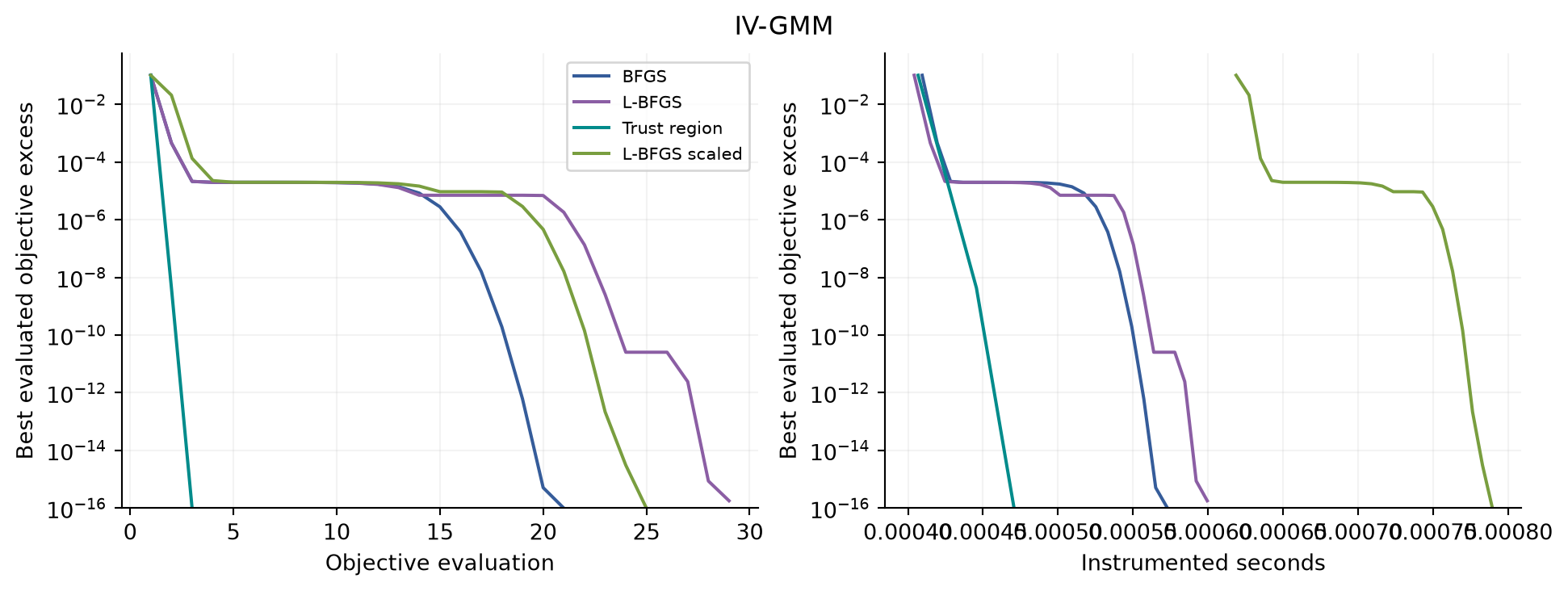
Each panel below retains the larger, stress-2, seed-0 diagnostic path. These curves include tracing overhead and plot the best evaluated objective, which can include trial points. They explain numerical behavior; the clean timing figure above supplies runtime comparisons. The raw trace records and the independently checked returned vectors are both downloadable.

Define the common convergence-panel formatting
def convergence_panel(family):
    fig, axes = plt.subplots(1, 2, figsize=(10, 3.7), constrained_layout=True)
    for method in METHODS:
        sub = traces[(traces.family == family) & (traces.method == method)]
        if sub.empty:
            continue
        envelope = np.maximum(np.minimum.accumulate(sub.excess.to_numpy()), 1e-16)
        for ax, key in zip(axes, ["evaluation", "elapsed"]):
            ax.plot(sub[key], envelope, label=method, color=COLORS[method], linewidth=1.5)
    for ax in axes:
        ax.set(yscale="log", ylabel="Best evaluated objective excess", ylim=(1e-16, None))
        ax.grid(alpha=.15)
    axes[0].set_xlabel("Objective evaluation")
    axes[1].set_xlabel("Instrumented seconds")
    axes[0].legend(fontsize=8)
    fig.suptitle(family)
    plt.show()

4.3.1 OLS

Show the computation
convergence_panel("OLS")
Figure 2: OLS: diagnostic evaluation and elapsed-time paths on the larger stress-2, seed-0 instance.

4.3.2 Ridge

Show the computation
convergence_panel("Ridge")
Figure 3: Ridge: diagnostic evaluation and elapsed-time paths on the larger stress-2, seed-0 instance.

4.3.3 Logit

Show the computation
convergence_panel("Logit")
Figure 4: Logit: diagnostic evaluation and elapsed-time paths on the larger stress-2, seed-0 instance.

4.3.4 Poisson

Show the computation
convergence_panel("Poisson")
Figure 5: Poisson: diagnostic evaluation and elapsed-time paths on the larger stress-2, seed-0 instance.

4.3.5 IV-GMM

Show the computation
convergence_panel("IV-GMM")
Figure 6: IV-GMM: diagnostic evaluation and elapsed-time paths on the larger stress-2, seed-0 instance.

4.3.6 NLS

Show the computation
convergence_panel("NLS")
Figure 7: NLS: diagnostic evaluation and elapsed-time paths on the larger stress-2, seed-0 instance.

5 Reproduction and limitations

This document contains all simulation, likelihood, reference, fitting, checking and plotting code. It executes without saved result inputs or local helper modules once the proposed CrabbyMetrics version and the existing test/docs extras are installed. The data-generating process is fixed across solvers; three timing repetitions do not constitute three independent simulated samples.

These methods are unconstrained local optimizers. The supplied derivatives and normalization must match the objective, separation or weak identification remain statistical issues, and a gradient certificate alone does not certify a global optimum. Trust-region checks of final negative curvature provide an additional local safeguard. No solver curvature is automatically exposed as a covariance.

All timed fits · Paired instance results · Diagnostic fits · Convergence traces · Environment